Is It Legal to Record Meetings? Consent Rules Explained
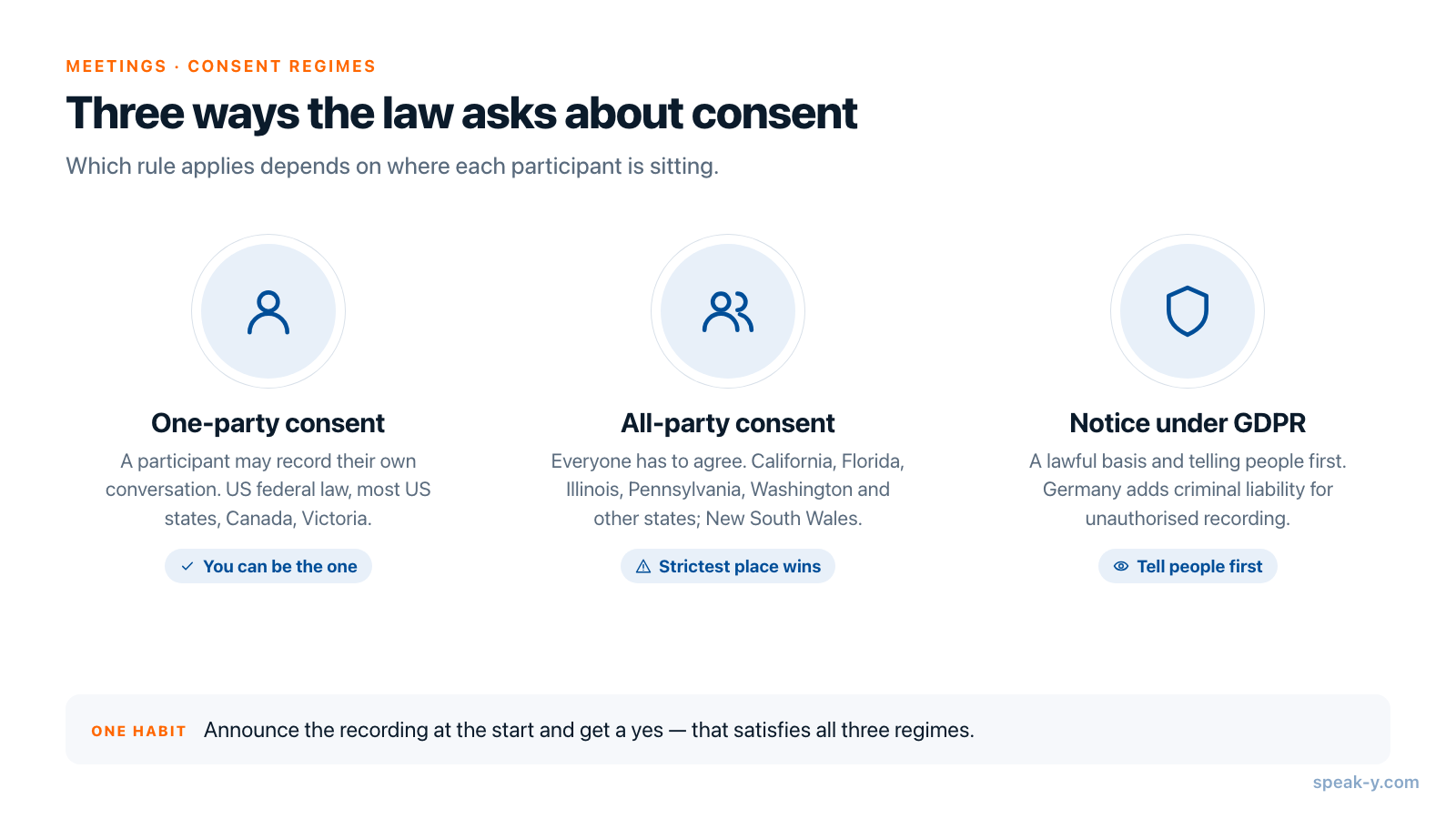
Recording a meeting is legal in most places if the people in it know. The details depend on where each participant is sitting: US federal law and most US states let a participant record a conversation they are part of, about a dozen states require everyone's consent, the EU treats a recorded work meeting as personal data that people must be told about first, and Germany makes secretly recording a non-public conversation a crime.
So the short, portable answer is: announce the recording at the start and get a yes before anything substantive is said. That single habit satisfies the strictest rules below, and it costs ten seconds.
The rest of this article explains why the rules differ, what the August 2026 ruling against Otter.ai adds to the picture, and what meeting platforms do and do not do for you. Laws and court documents below were checked on 29 September 2026. This is general information, not legal advice — for a specific situation, ask a lawyer in the relevant jurisdiction.
What is the difference between one-party and all-party consent?
One-party consent means that one participant agreeing to the recording is enough — and that participant can be you. The US federal Wiretap Act works this way: 18 U.S.C. § 2511(2)(d) says it is not unlawful for a person to record a communication "where such person is a party to the communication", unless the recording is made to commit a crime or a tort. Most US states follow the same model.
All-party consent (often called two-party consent) means every participant has to agree. Published lists differ at the edges, but California, Florida, Illinois, Maryland, Massachusetts, Montana, New Hampshire, Pennsylvania and Washington appear on all of them. Connecticut, Delaware and Nevada are usually added with caveats — Connecticut, for example, applies the stricter rule to phone and video calls but not to in-person conversations. Oregon does the opposite: one-party for calls, all-party for face-to-face talk. Michigan's statute reads as all-party, but its courts allow a participant to record.
The stakes are real. California Penal Code § 632 covers "confidential communications" — anything said in circumstances suggesting the speaker wants it kept among the participants, which describes most internal meetings — and § 637.2 lets anyone recorded in violation sue for $5,000 per violation.
Which law applies when participants are in different places?
Video calls routinely span several states and countries, and the conservative reading is that the strictest location wins. The leading example is Kearney v. Salomon Smith Barney (California Supreme Court, 2006): brokers in Georgia, a one-party state, recorded calls with clients in California. The court held that California's all-party rule applies to calls into California, whichever state the recording is made in.
In practice nobody knows where every attendee of a 12-person call is sitting, which is why "announce and get a yes" beats trying to work out each person's jurisdiction. It turns the question from which law applies into did everyone agree, and that answer is the same everywhere.
What changes in Europe and the UK?
In the EU the question is framed differently. Recording a person's voice is processing personal data, so GDPR applies — unless it happens "in the course of a purely personal or household activity" (Article 2(2)(c)), and a work meeting does not qualify.
GDPR does not always require consent in its narrow legal sense. An organisation can rely on another lawful basis, most often legitimate interests. What it does require in every case is transparency: people must be told before recording starts that it is happening, why, and how long the recording is kept. The UK applies the same logic to organisations under the UK GDPR.
National criminal law can be stricter than GDPR. In Germany, § 201 of the Criminal Code punishes anyone who records the non-public spoken word of another without authorisation — or uses or passes such a recording on — with up to three years in prison or a fine. Commentary on the provision stresses that the recording does not have to be secret to be unlawful: starting it against someone's recognisable objection is enough.
Elsewhere the picture is mixed. Canada's Criminal Code (section 184) allows a participant to record their own conversation. Australia varies by state: Victoria lets a participant record but restricts sharing the recording, while New South Wales generally requires the consent of everyone in the conversation.
Does it matter whether a bot or an app does the recording?
For the people being recorded, no: consent rules attach to the conversation, not to the software. But the August 2026 ruling in In re Otter.AI Privacy Litigation (N.D. Cal., No. 5:25-cv-06911) shows that the software can add a second question.
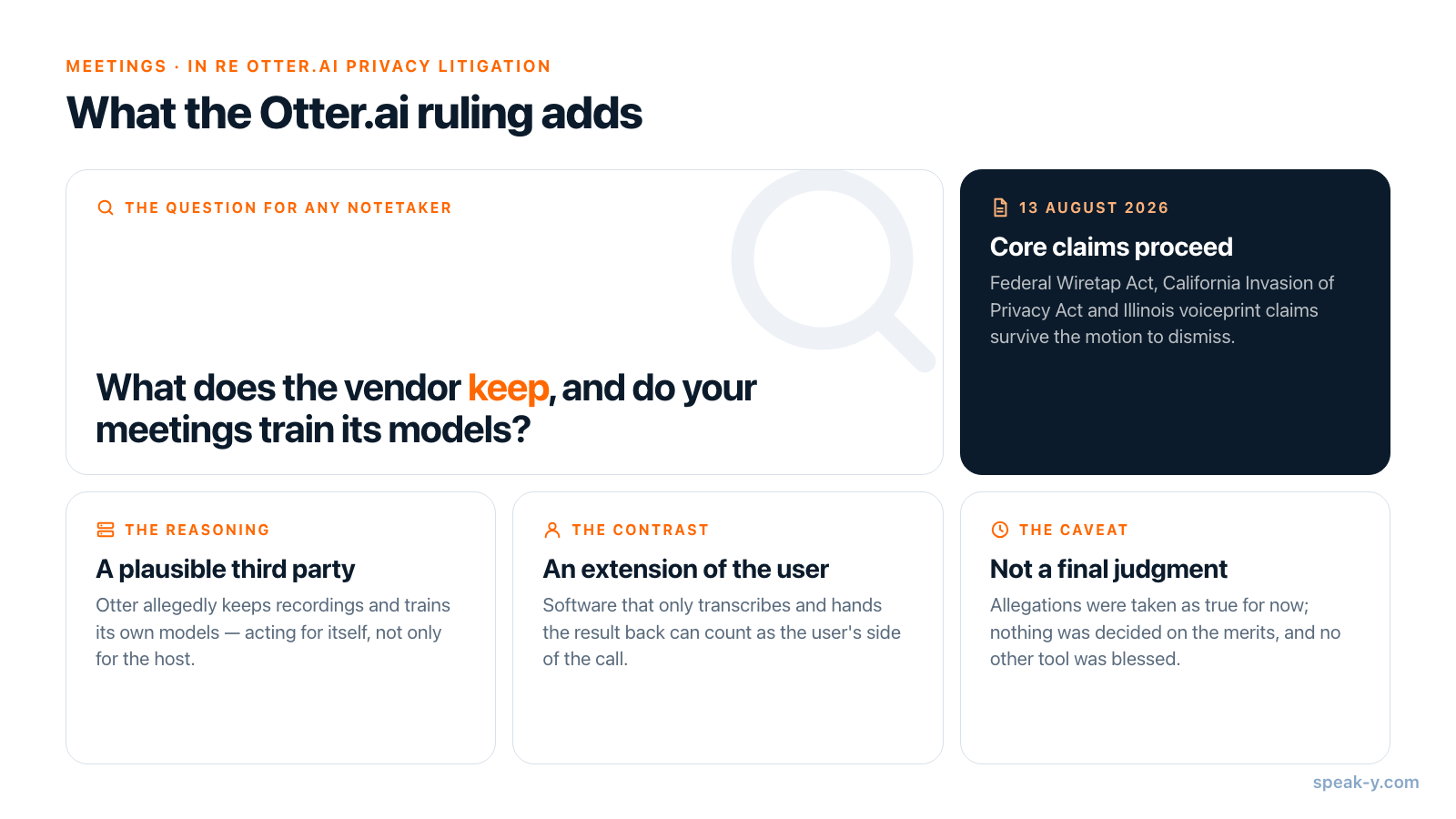
On 13 August 2026 Judge Eumi K. Lee granted Otter's motion to dismiss in part and denied it in part. The claims that survived include the federal Wiretap Act, the California Invasion of Privacy Act and Illinois biometric-privacy claims over voiceprints; claims under the federal Computer Fraud and Abuse Act and the Washington privacy statute were dismissed, with leave to amend.
The reasoning is the useful part. Software that works purely as an extension of its user can count as part of that user's side of the conversation. The court found it plausible that Otter is instead a third-party eavesdropper, because it allegedly keeps the recordings and uses them to train its own models — acting for its own commercial benefit rather than only transcribing for the host.
Two caveats matter. This is a ruling on a motion to dismiss: the court accepted the complaint's allegations as true for now and decided nothing on the merits. And it does not bless any other tool — it only shows which facts the court cared about. For anyone choosing a notetaker, the practical questions are what the vendor keeps, for how long, and whether your meetings train its models.
What do Zoom, Teams and Meet do for you?
Their own recording features handle notice for you — for their own recordings only:
- Zoom always notifies participants when a cloud or local Zoom recording starts, and account admins can show a consent disclaimer that participants must accept or leave the meeting.
- Microsoft Teams shows a recording banner, and admins can turn on explicit recording consent: participants stay muted, with camera and screen sharing off, until they agree to be included. The policy is off by default.
- Google Meet notifies participants whenever a recording starts or stops.
None of this covers a recorder the platform does not know about — a desktop app, a phone on the table, or a third-party bot that has been admitted to the call. In those cases the platform shows nothing, and the announcement is yours to make.
A routine that holds up in most places
The rules above collapse into a handful of habits. They are not a substitute for legal advice in a regulated setting — healthcare, finance, hiring — but they cover ordinary work meetings in the strictest jurisdictions:
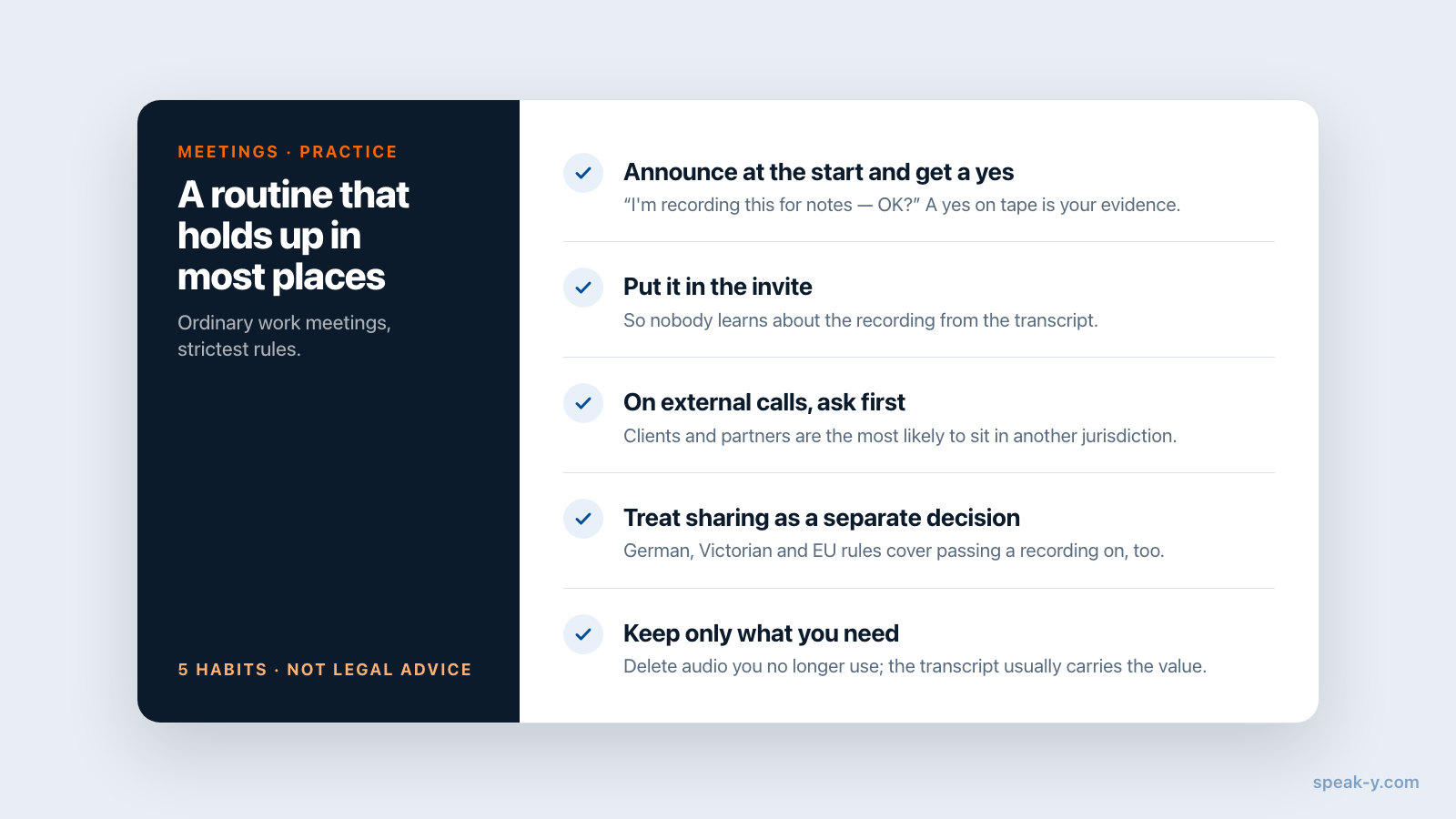
- Announce at the start and get a yes. "I'm recording this for notes — is everyone OK with that?" Record the answer too; it is your evidence of consent.
- Put it in the invite for recurring internal meetings, so nobody learns about the recording from the transcript.
- On external calls, ask first and offer to stop. Clients, candidates and partners are the people most likely to be in a different jurisdiction.
- Treat sharing as a separate decision. German law, Victorian law and GDPR all regulate passing a recording on, not only making it.
- Keep only what you need. Delete audio you no longer use; a transcript and a summary usually carry the value.
Where Speak-Y fits
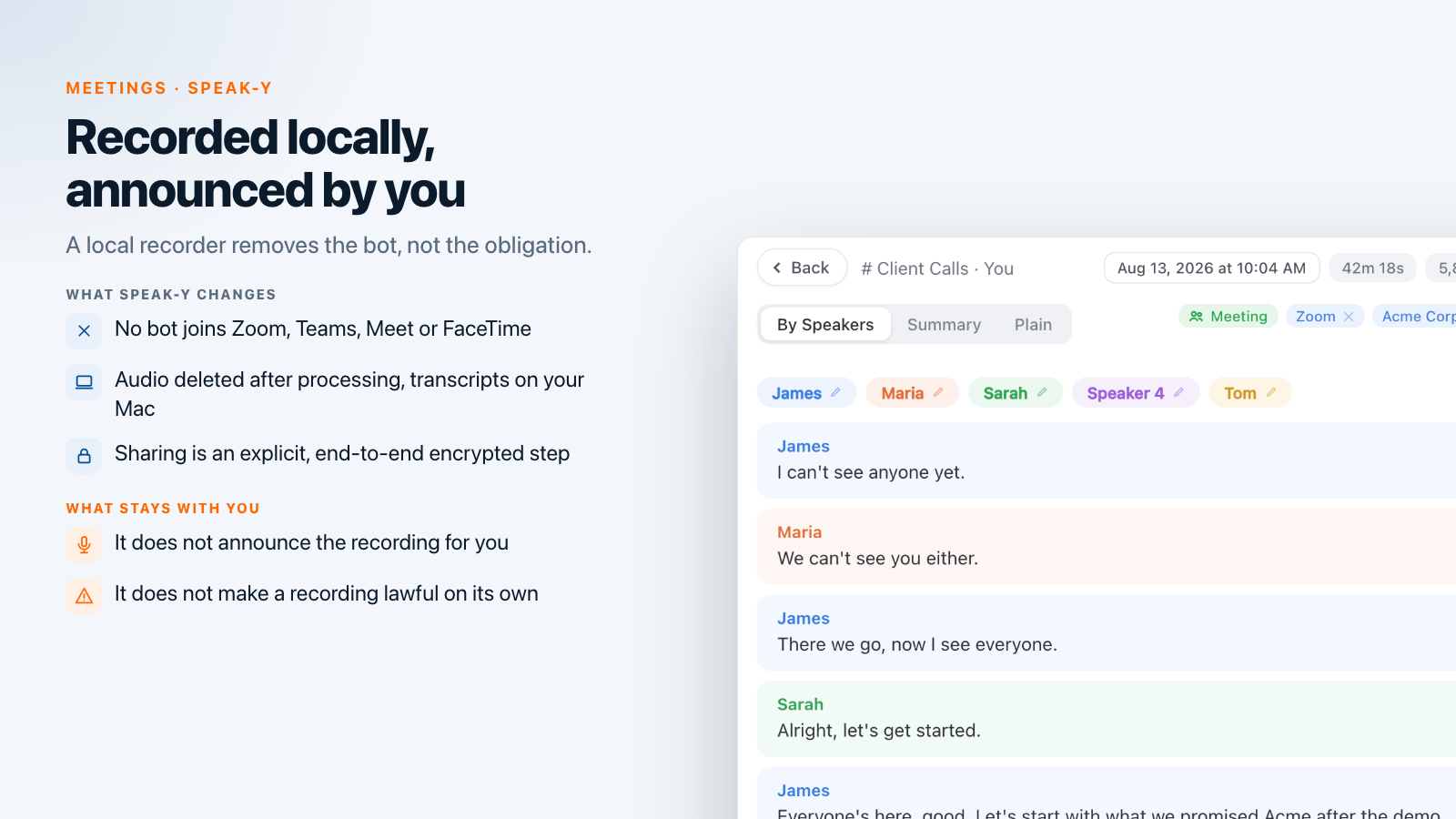
Speak-Y's meeting mode records calls locally on your Mac — Zoom, Microsoft Teams, Google Meet, FaceTime or anything else that plays audio — with no bot joining the call. That removes the bot, not the obligation: nobody in the meeting sees a notice from Speak-Y, so the announcement from the routine above is on you.
What it does change is the vendor side of the question. Audio is deleted after processing, transcripts are stored on your device, and none of your data is used to train AI models, as the privacy policy states. Passing a recording on is an explicit action: you choose to share it into an end-to-end encrypted team channel, and nothing leaves your machine for colleagues otherwise.
If you are still deciding between a notetaker bot and a local recorder, the practical differences — what colleagues see and what admins now block — are in How to Record Meetings Without a Bot Joining the Call, and why meeting notes need end-to-end encryption covers what happens to a transcript once it is shared.
FAQ
Is it legal to record a meeting without telling anyone?
It depends on where the participants are. US federal law and most US states allow a participant to record a conversation they are part of, but roughly a dozen states require everyone's consent, and in the EU recording a work meeting is data processing that requires telling people first. Germany treats secretly recording a non-public conversation as a criminal offence. Telling everyone at the start is the only habit that is safe everywhere.
Which states require all-party consent to record?
Lists vary slightly, but California, Florida, Illinois, Maryland, Massachusetts, Montana, New Hampshire, Pennsylvania and Washington appear on all of them. Connecticut, Delaware and Nevada are usually added with caveats, and Oregon requires all-party consent for in-person conversations only. When a call includes someone in one of these states, plan for the stricter rule.
Does GDPR require consent to record a meeting?
Not necessarily consent in the narrow GDPR sense — an organisation can rely on another lawful basis such as legitimate interests. But GDPR does require telling people before the recording starts, what it is for and how long it is kept. It does not apply to a purely personal or household activity, which a work meeting is not.
What did the court decide in the Otter.ai lawsuit?
On 13 August 2026 Judge Eumi K. Lee (N.D. Cal.) allowed the core claims in In re Otter.AI Privacy Litigation to proceed, including federal Wiretap Act, California Invasion of Privacy Act and Illinois biometric claims. The court treated Otter as a plausible third-party eavesdropper because it allegedly retains recordings and uses them to train its own models, rather than acting only as the host's tool. It is a ruling on a motion to dismiss, not a final judgment.
Does recording locally instead of with a bot change the legal rules?
No. Consent rules are about the people being recorded, not about the software. A local recorder removes the visible bot, so announcing the recording becomes entirely your job. What it can change is the vendor question: a tool that keeps audio and trains on it adds a third party to the conversation, while one that processes the audio and hands the result back to you does not.