Turn Meetings Into a Team Knowledge Base That People Use
Every team already records more than it remembers. Calls get transcribed, summaries get generated, action items get extracted — and then all of it sits in a folder nobody opens. Six weeks later someone asks "why did we decide to drop the Postgres migration?" and three people spend twenty minutes reconstructing a conversation that was captured perfectly at the time.
The gap is not capture. It is retrieval, and it is a design problem: a pile of transcripts is not a knowledge base. This article covers how to turn meetings into a team memory people actually query — what to share, how to organize it, what to deliberately keep out, and why the encryption model matters more than it looks.
What separates a knowledge base from an archive
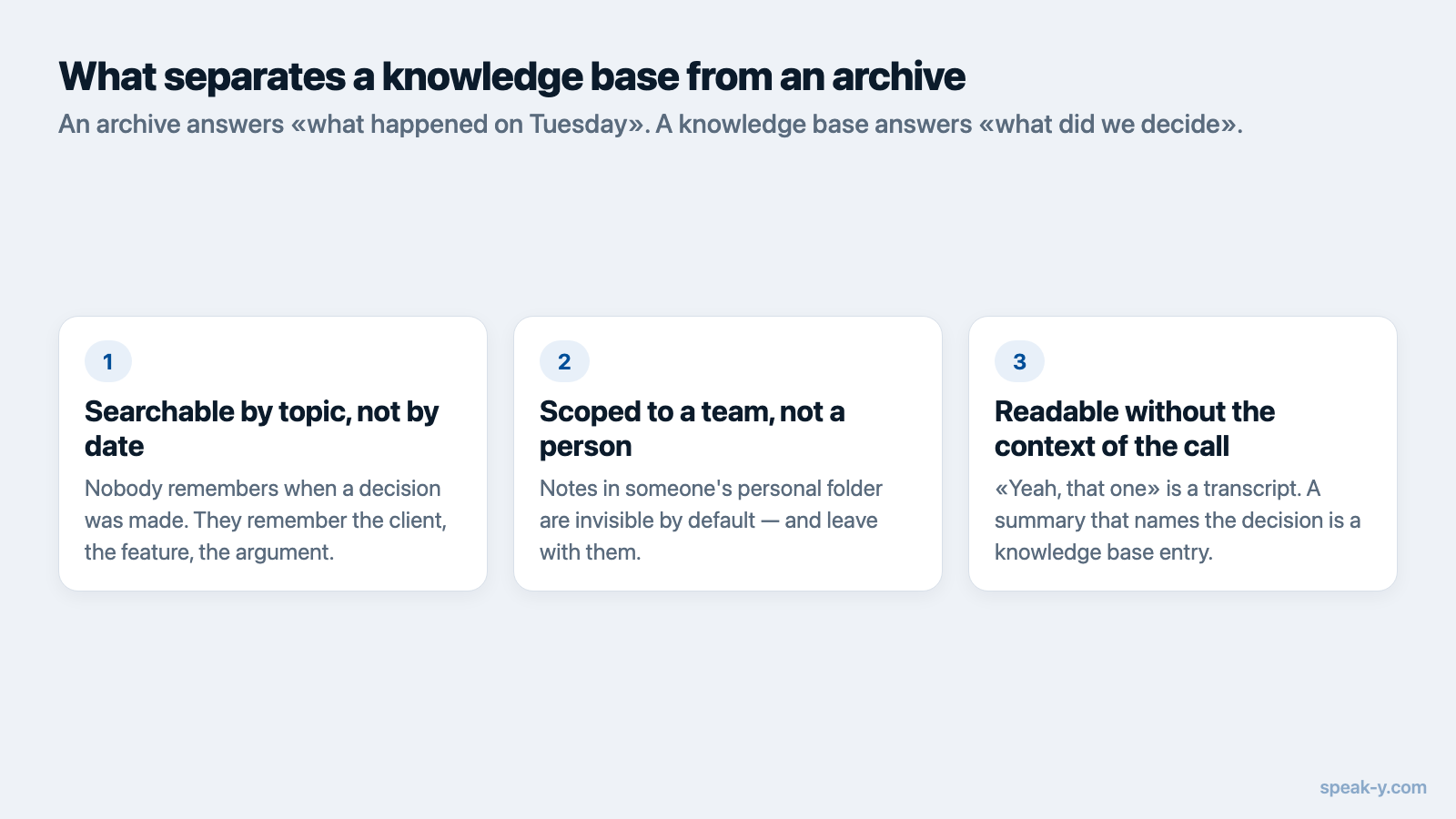
An archive answers "what happened on Tuesday". A knowledge base answers "what did we decide about pricing, and why". Three properties make the difference:
Searchable by topic, not by date. Nobody remembers when a decision was made. They remember what it was about. If finding something requires knowing the meeting date, you have an archive.
Scoped to a team, not a person. Notes in someone's personal folder are invisible by default. A knowledge base has channels — shared spaces where the record belongs to the group.
Readable without context. A transcript of a call where three people say "yeah, that one" is not a record of anything. Summaries and extracted action items are what make the content survive the loss of the room.
What to share — and what to keep out
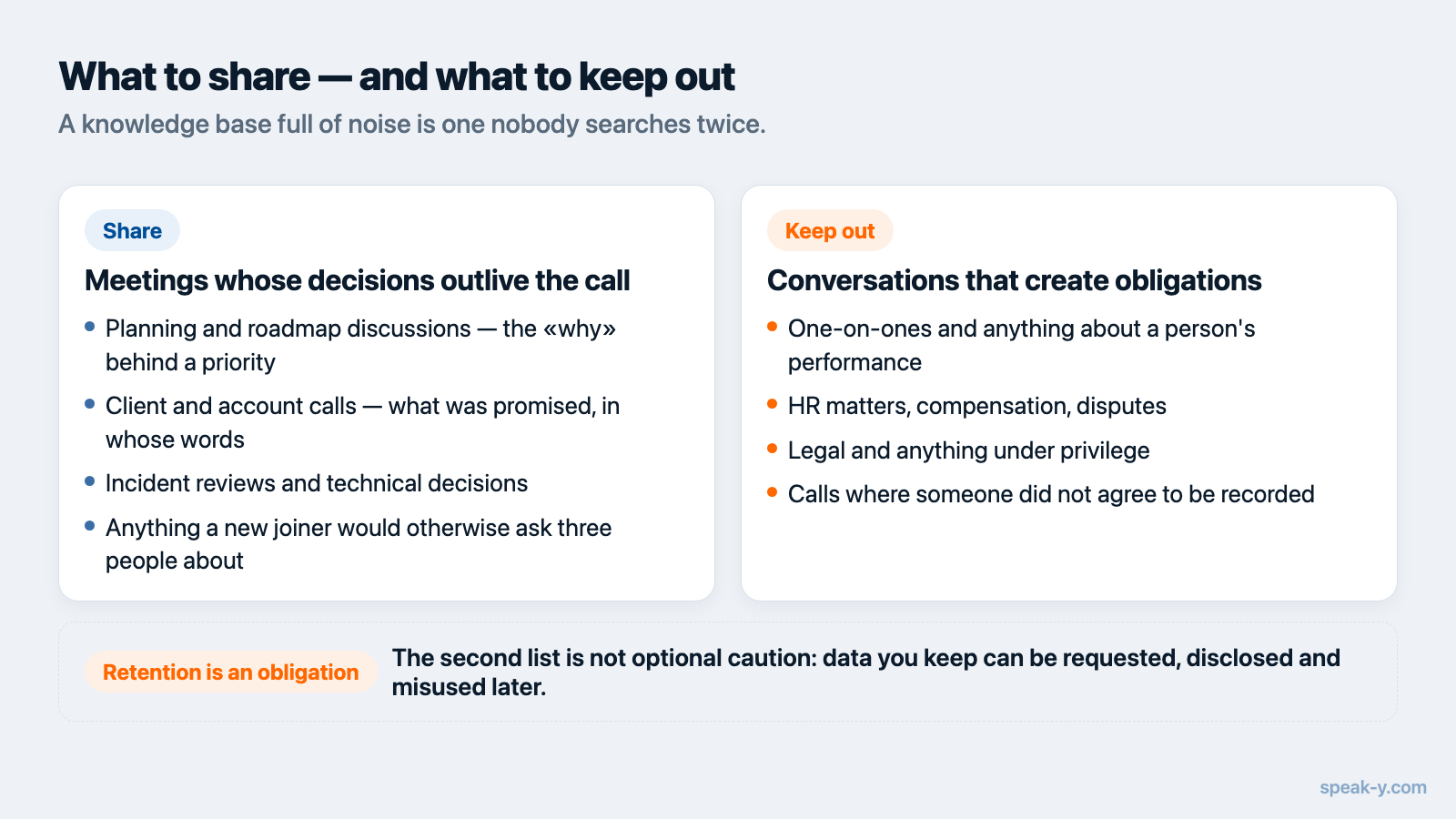
The instinct is to share everything, and it is wrong. A knowledge base full of noise is one nobody trusts, and some meetings carry real risk if they are retained at all.
Share meetings whose decisions outlive the call:
- Planning and roadmap discussions — the "why" behind a priority is the thing that gets lost first.
- Client and sales calls — what was promised, in whose words.
- Architecture and technical decisions — including the options you rejected.
- Incident reviews — the timeline while it is still accurate.
- Onboarding sessions — record once, replay for every future hire.
Keep out entirely:
- One-on-ones and any conversation about a specific person's performance.
- HR matters, compensation, disciplinary discussions.
- Legal conversations, especially anything touching privilege.
- Anything a participant asked not to be recorded — no exceptions, and this should be a stated team norm rather than a case-by-case judgement.
The second list is not optional caution. Retention creates obligations: data you keep can be requested, subpoenaed or breached, and "we recorded everything by default" is a bad position to explain afterwards.
Organize channels around retrieval, not around org chart
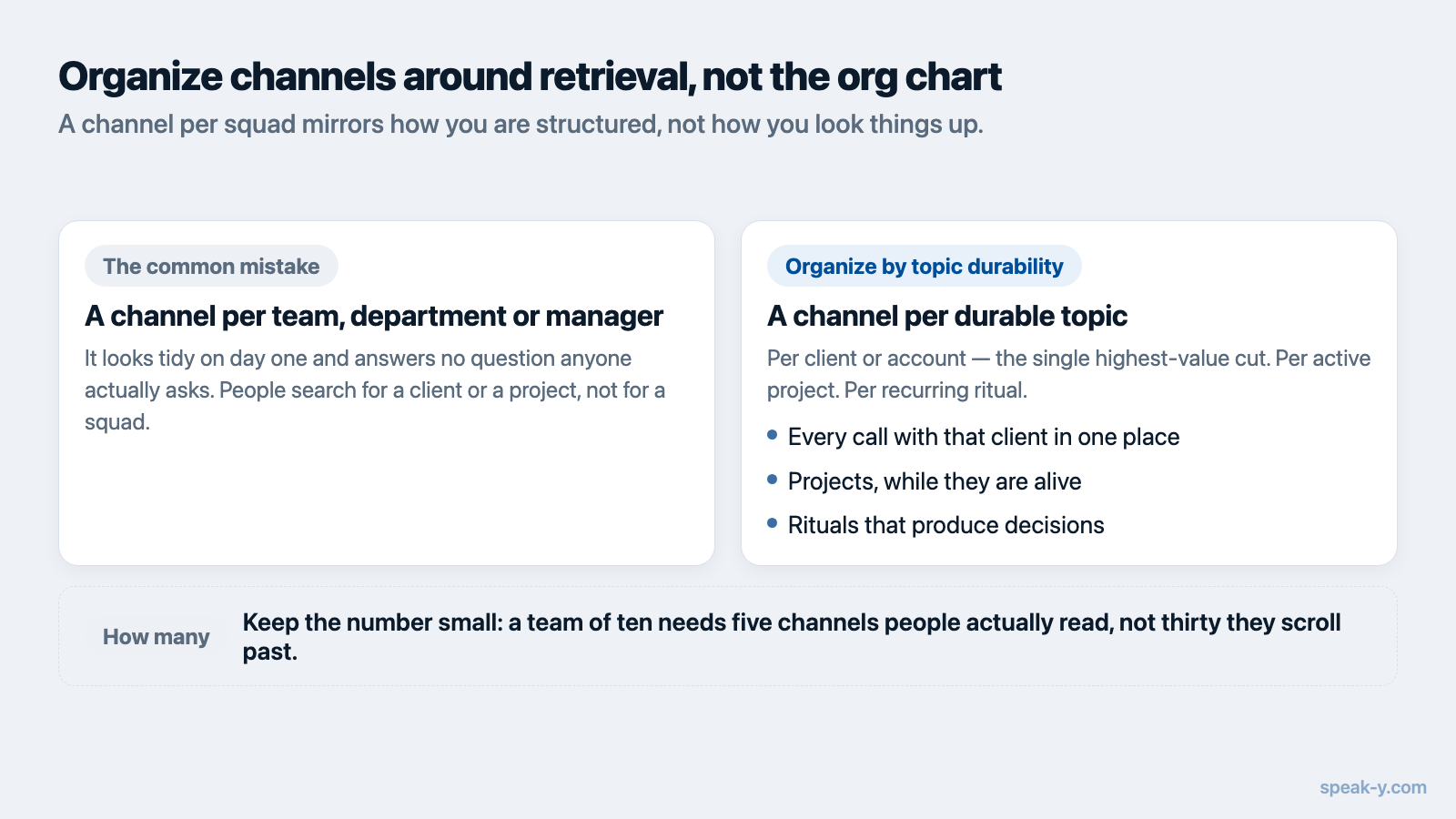
The most common mistake is mirroring your team structure: a channel per squad, per department, per manager. It feels tidy and it fails, because people search by subject and your org chart changes twice a year.
Organize by topic durability instead:
- Per client or account — every call with that client in one place. This is the single highest-value pattern for agencies and consultancies.
- Per project or workstream — for the life of the project, then archived intact rather than deleted.
- Per recurring ritual — planning, retros, incident reviews. These benefit from being a continuous series you can read backwards.
- One general channel for company-wide sessions.
Keep the number small. A team of ten does not need thirty channels; it needs five that are actually used. Channels are cheap to create and expensive to maintain, and an unused channel is worse than no channel — it splits the record.
Make the record queryable by your AI assistant
This is where a knowledge base stops being a filing cabinet. Once meeting content is stored in a structured way, an AI assistant can read it directly through the Model Context Protocol — you ask a question in plain language and it retrieves the answer from the actual transcripts:
- "What did we promise this client about the migration timeline?"
- "Summarize every objection raised in sales calls this quarter."
- "What action items from last month are still unresolved?"
The practical effect is that the value of the knowledge base no longer depends on someone having written a good summary. The raw record becomes useful directly, which removes the discipline problem that kills most documentation efforts. The setup guide covers how to connect Claude, Cursor, ChatGPT and other MCP clients.
Why the encryption model is the load-bearing part
A team knowledge base concentrates your most sensitive conversations — strategy, clients, incidents, pricing — into a single searchable store. That concentration is the whole point, and it is also exactly what makes the store a target.
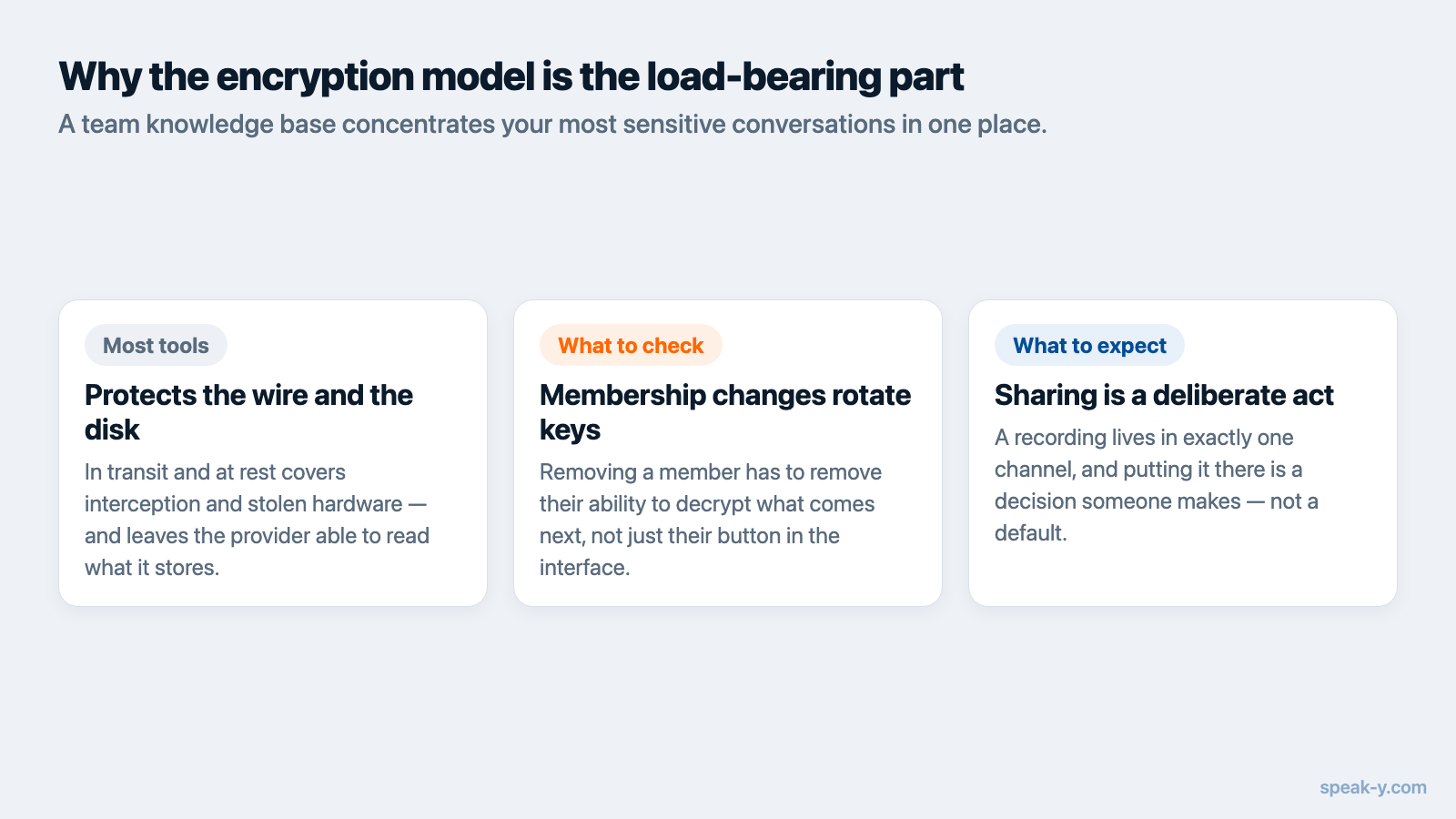
Most meeting tools encrypt data in transit and at rest, which protects against interception and stolen disks but not against the vendor itself: the provider holds the keys, so provider staff, a compromised provider account, or a legal order can all reach the content. End-to-end encryption changes the shape of the problem — channel keys exist only on the team's own devices, so the server stores ciphertext it cannot read.
Two consequences worth understanding before you commit a team to any tool:
- Membership changes must rotate keys. In Speak-Y Teams, removing a member rotates the channel keys immediately, so their device loses access to future content. This is a property of the key model rather than a permission flag — permission flags can be misconfigured, and a revoked flag on a server you do not control is a promise, not a mechanism.
- Sharing outside the team is a separate decision. Secure public share links let you hand a specific meeting to a client without giving them an account or access to anything else.
Start smaller than you think
The failure mode of knowledge-base projects is launching with fifteen channels, a taxonomy and a naming convention, then watching all of it go stale in a month. A start that survives looks like this:
- Two channels. One recurring ritual, one active project.
- One norm about consent. Say at the top of a recorded call that it is recorded and where it will live. Once, out loud, every time.
- Two weeks of just accumulating. Do not reorganize anything yet.
- Then ask it a real question — one you would otherwise have asked a colleague. That single moment is what converts the team, not the launch announcement.
Retrieval is what makes people contribute. Once someone finds an answer they would have had to interrupt three people for, sharing stops being an administrative chore and starts being obviously in their own interest.
In Speak-Y, creating a workspace starts on Pro and teammates you invite join free on any plan, so the cost does not scale with headcount — one fewer reason to keep the knowledge base small when it should grow. Recordings themselves stay on the device that made them by default; sharing into a channel is always a deliberate act, never the default.
FAQ
What is a meeting knowledge base?
A searchable record of what your team discussed and decided, built from meeting transcripts, summaries and action items rather than from hand-written notes. The point is retrieval: finding a decision months later without asking the people who made it.
Should every meeting go into the knowledge base?
No. Share meetings whose decisions outlive the call — planning, client calls, architecture, incidents, onboarding. Keep one-on-ones, HR conversations, performance reviews and legal discussions out of it entirely.
Why does encryption matter for a team knowledge base?
It concentrates your most sensitive discussions in one place, which makes it a target. With end-to-end encryption the channel keys exist only on your team's devices, so the vendor cannot read the content even if compelled to.
What happens when someone leaves the team?
In Speak-Y, removing a member rotates the channel keys immediately, so their device loses access to future content in that channel. That is a property of the key model, not a permission flag that can be misconfigured.
Do teammates need a paid plan to participate?
In Speak-Y, creating a workspace requires Pro, but teammates you invite join free on any plan — so the cost does not scale with team size.