Board Meeting Notes in a Private Channel: A Founder's Setup
Board and investor material is the one part of a startup's meeting history that most of the team should not read: the runway discussion before it goes to the all-hands, the conversation about a co-founder's role, the term sheet you have not accepted yet. If your team already shares meetings in Speak-Y, the place for this material is a private channel, here called Board, with two or three members — you, a co-founder, perhaps the CFO.
A private channel is not a folder hidden from view. Its recordings are encrypted with a key that only its members' devices hold, so a teammate who is not in it cannot read them, and neither can the server. For an outside director who needs one meeting, you send a public link that works for 7 days instead of an invite. And some things — the formal board meeting itself, privileged sessions with counsel — are better kept out of the channel altogether.
This guide follows the macOS app as of 17 October 2026 and an ordinary seed-stage company: a founder who owns the workspace, a co-founder, a part-time CFO and one independent director.
What belongs in a Board channel?
The Board channel is for meetings where the founder is preparing for, or following up on, the board — the material the leadership circle needs and the team does not:
- Prep calls — you and your co-founder rehearsing the board update, deciding which numbers to show and which questions to expect.
- Debriefs — the ten minutes after the board meeting, while the feedback is fresh: what directors pushed on, what you agreed to come back with.
- Investor calls between rounds: updates to existing investors, bridge conversations, anything about valuation.
- People decisions at the top: equity, a co-founder's role, an executive hire before it is announced.
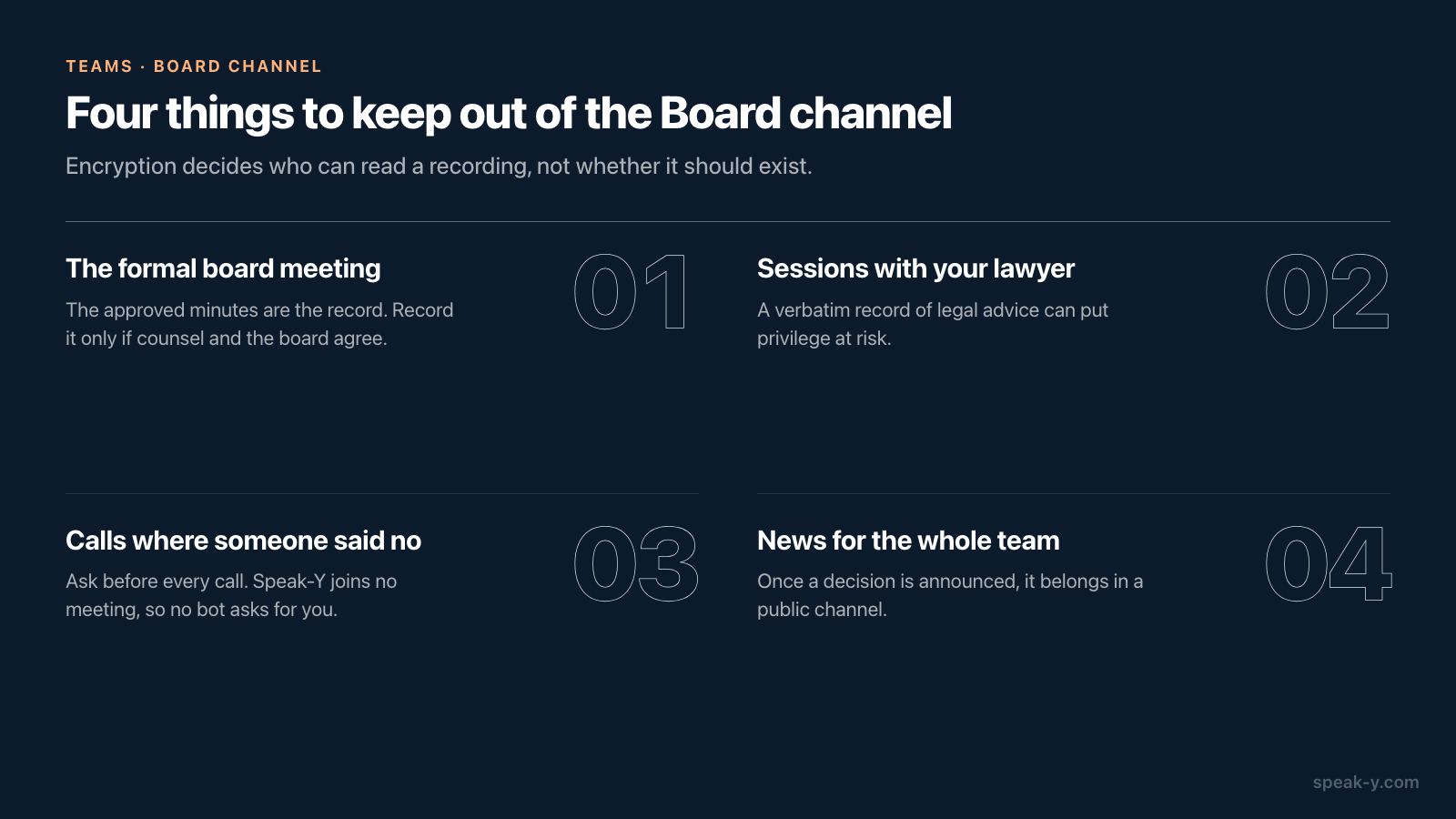
A channel works when someone will look for its meetings later. Three months on, "what did we tell the board about runway in July" is a search in one channel, not a hunt through your personal recordings. The flip side: once a decision is announced to the company, the meetings that carry it out belong in a public channel, not in Board.
Setting up the Board channel
Any member of a workspace can create a private channel; the steps are the same as in the video above.
- In the sidebar, open the workspace's ⋯ menu and choose New channel.
- Name it Board.
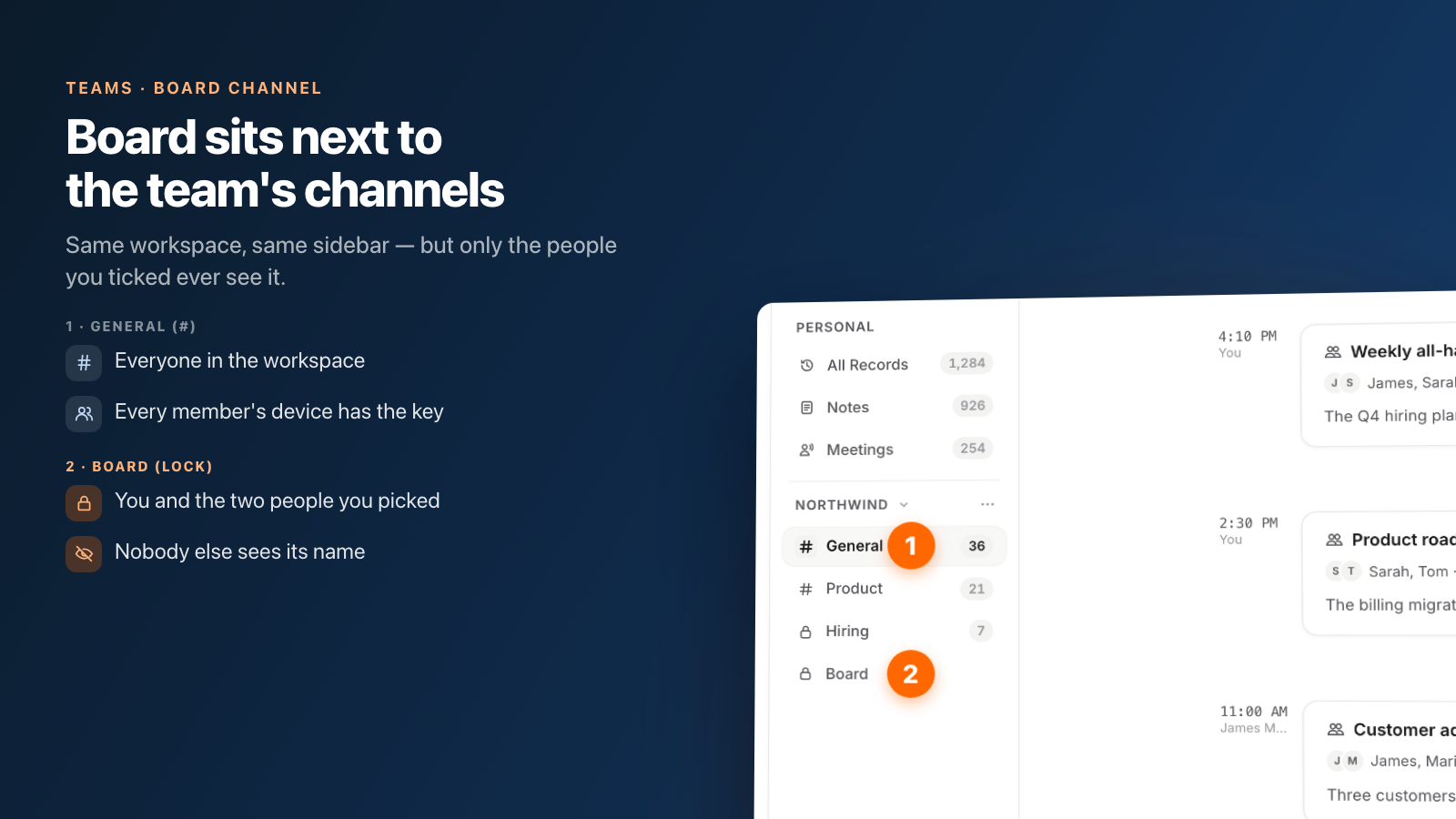
- Switch the type to Private. The sheet explains it in one line: "Visible only to you and the members you pick. The workspace owner can restore access with the Recovery Kit."
- Under Who can see this channel, tick the people who should read it — in our example, the co-founder and the CFO.
- A teammate who is greyed out "hasn't activated encryption yet" and cannot receive the key: they have to open Speak-Y and set their encryption password first.
- Click Create channel. Board appears in the sidebar with a lock.
From then on, a recording goes into the channel from its own screen: To channel in the action bar under the transcript, then Board. Create the channel yourself rather than asking an admin to: only the channel's creator can remove a member from a private channel or change its type later.
Why is "private" a key and not a hidden folder?
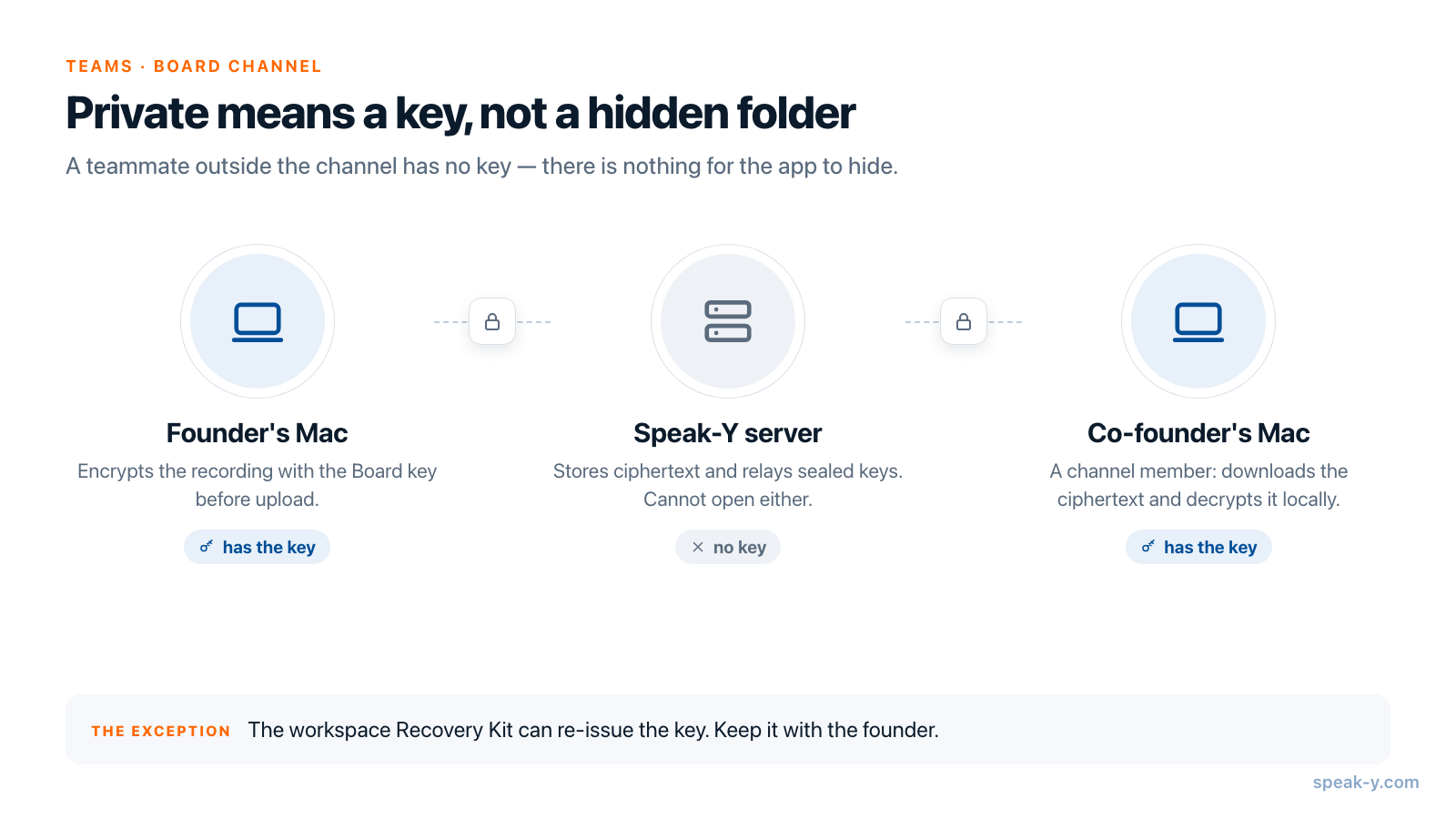
In many tools, "private" means the interface does not show an item to people without permission, while the service itself can read everything. Speak-Y works differently. Each channel has its own key. When you send a recording to Board, your Mac encrypts it with that key before upload; the server stores ciphertext; a member's Mac downloads and decrypts it. The key is handed only to the devices of the people in the channel, sealed so that the server can relay it but never open it. Even the channel's name is encrypted on your device.
Three practical consequences for a Board channel:
- The rest of the workspace does not see it, owner included. A teammate who was not added has no key, so there is nothing for the app to hide — it has nothing it could show.
- Removing someone works cryptographically. When the creator removes a member, the channel key is rotated and that person loses access to all records in it. What they already read on their own device stays with them, as in any encrypted system.
- The Recovery Kit is the exception to plan for. The workspace Recovery Kit — the file saved when the workspace was created — can re-issue any channel's key to a member who reset their password. Whoever holds the Kit can restore access to Board, so it belongs with the founder, not in a shared drive.
The mechanism is described in more detail in how end-to-end team sharing works.
What about an outside board member?
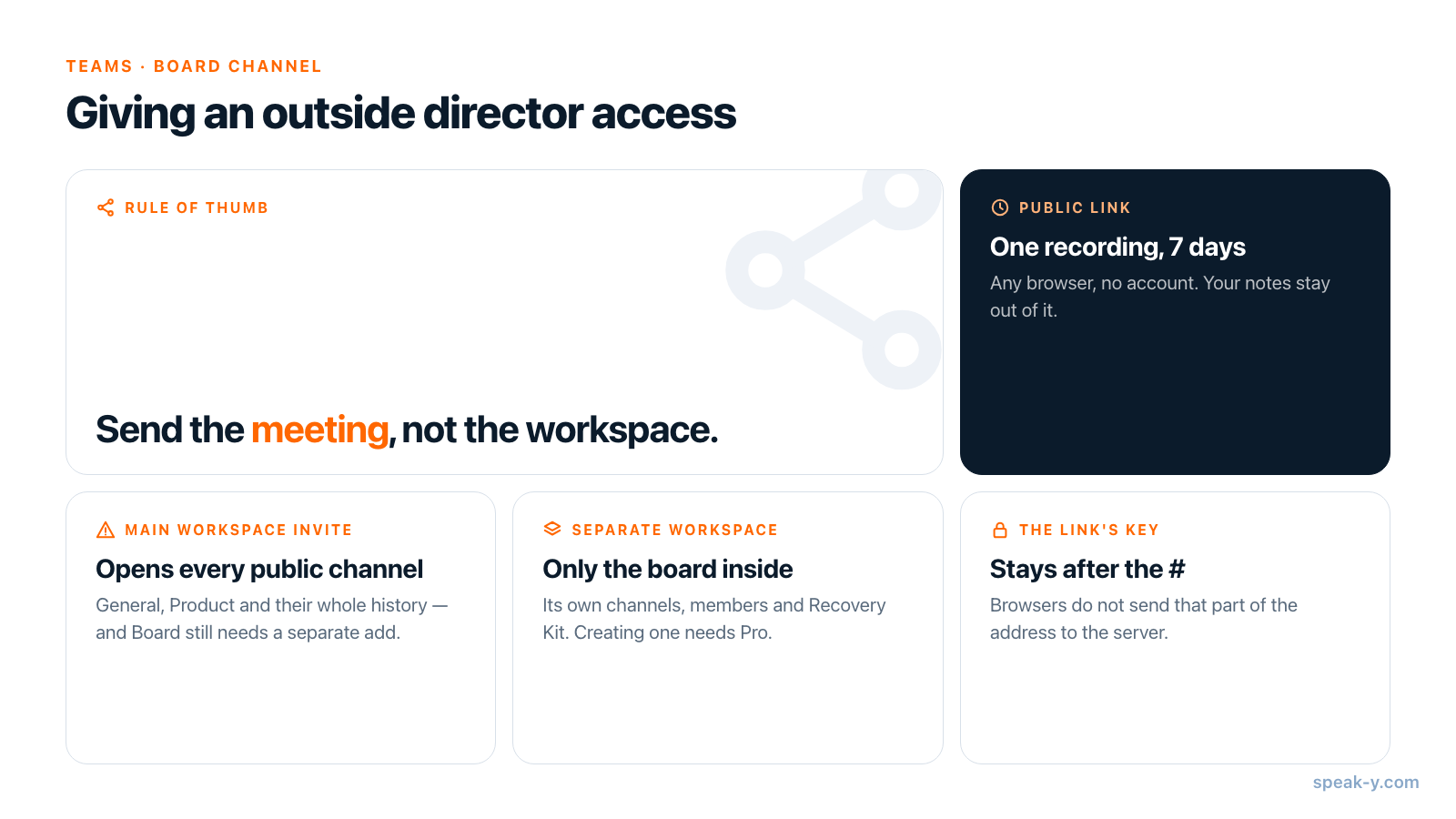
An independent director or an investor on your board is not part of the team, and they rarely need more than a few meetings a year. There are three ways to give them access, and they open very different amounts:
- A public link to one recording. Open the recording and click Public
link under the transcript; the link is already on your clipboard. The
director opens it in any browser without an account and sees the summary and
the transcript by speaker. The link works for 7 days, and the key to the
content travels only in the part of the address after
#, which browsers do not send to the server. Your notes on the recording are private by default and are not included. - An invite to your main workspace. Avoid this one. A workspace member sees every public channel and its whole history — General, Product, everything — and you would still have to add them to Board.
- A separate workspace for the board. If a director needs every board-related meeting, create a second workspace (New workspace in the same ⋯ menu) with only the board in it. "A workspace has its own channels, members and Recovery Kit." Creating a workspace needs a Pro plan; people you invite join free on any plan.
For most seed-stage boards the first option is enough: one link after each meeting that matters, gone by itself a week later. The public link guide covers what the recipient sees and when a link is revoked early.
Should you record the board meeting itself?
This is a question for your company's counsel, not for a notes app, and the answer is often no. Corporate lawyers have long advised against recording formal board meetings, and AI transcription has made the point sharper.
In June 2026, partners at Skadden wrote on the Harvard Law School Forum on Corporate Governance that AI recordings, transcripts and summaries of board meetings would likely have to be produced in litigation, that a director's exchanges with an AI tool are generally not privileged, and that traditional minutes deliberately leave out much of what a transcript captures. In September 2026, Sidley described a Delaware Court of Chancery case, ATG Capital Opportunities Fund LP v. Lane (28 August 2026), in which the minutes said a defensive measure was adopted to protect stockholders, while the AI transcript had the chairman describing it as necessary for the board to stay in place; the court cited the transcripts when weighing the board's motives.
The practical line for a founder:
- The minutes are the official record of a board meeting, drafted carefully and approved by the directors. A transcript is not a substitute.
- Record your own side — prep and debrief calls with your co-founder — and ask before every call whether recording is fine. Speak-Y records on your Mac and never joins Zoom, Google Meet or Teams, so no bot announces it for you.
- Keep sessions with counsel off the record. Legal advice is where a verbatim third-party record can put privilege at risk; a lawyer's own notes serve that meeting better than a transcript.
- If the board agrees to transcription, agree with counsel which meetings, who keeps the text, and when it is deleted once the minutes are approved. Once litigation is reasonably anticipated, deletion stops: AI-generated material then has to be preserved.
Whether you need consent from everyone on the call depends on where the participants are; the legal basics of recording meetings covers that part.
The short version
Give board and investor material its own private channel, created by you, with only the two or three people who need it. Keep the Recovery Kit with the founder. Send outside directors a 7-day link to the one meeting they need instead of an invite, and leave the formal board meeting to the minutes unless counsel says otherwise.
For the rest of the team's channels — which to make public, which private and the access mistakes that are hard to undo — see team meeting channels: who sees what and the Teams page.
FAQ
How do I keep board meeting notes separate from my team in Speak-Y?
Create a private channel in your workspace: New channel in the workspace's ⋯ menu, type Private, and tick only the two or three people who should read it, such as a co-founder and the CFO. Recordings you send to that channel with To channel are readable only by its members; everyone else in the workspace does not see the channel at all.
Can the workspace owner read a private channel they are not a member of?
Not in the app: a private channel is invisible to workspace members who were not added, the owner included. The one exception is the workspace Recovery Kit, the file saved when the workspace was created, which can re-issue a private channel's key to a member. Whoever holds the Kit can therefore restore access, so for a Board channel the Kit should stay with the founder.
How do I share board notes with an outside director who is not on the team?
For one meeting, send a public link: click Public link under the recording and the link is copied. The director opens it in any browser without an account, and it stops working after 7 days. If the director needs every board meeting, invite them to a separate workspace used only for the board, because a member of your main workspace sees all of its public channels.
Should a startup record its board meetings?
Talk to your company's counsel first. Lawyers commonly advise against recording or transcribing formal board meetings, because a transcript can be requested in litigation and may be compared with the official minutes. Founders usually get more value from recording their own prep and debrief calls and keeping the formal record in the minutes.
Can the server read what is in a private Speak-Y channel?
No. Channel recordings are end-to-end encrypted: they are encrypted on the sender's Mac with a channel key that only members' devices hold, and the server stores ciphertext it cannot open. Even the channel name is encrypted on the device.