Research Lab Meetings: Record Them Into One Channel for the Group
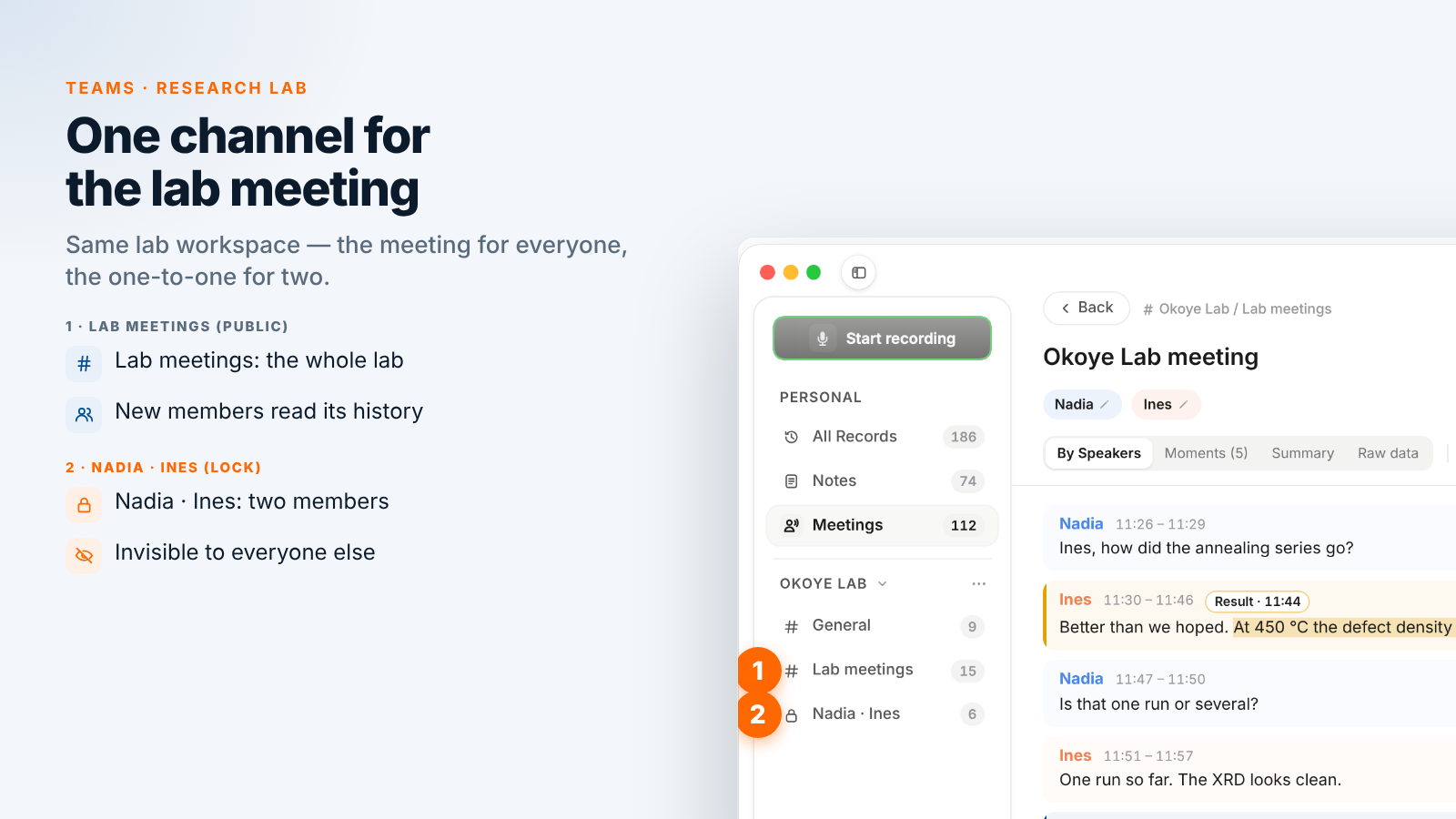
A research group decides a lot in its weekly lab meeting: which result is solid enough for the paper, which run to repeat, who books the instrument. Most of it lives only in the memory of the people in the room, and every new student gets a retelling. In Speak-Y you record the lab meeting on your Mac without a bot, mark results and decisions with a key while people talk, and share the transcript to a Lab meetings channel that the whole group reads. A new student who joins the workspace gets the history of that channel instead of a summary from memory, and one-to-ones between supervisor and student go to a private channel with two members.
This guide follows one group: Nadia Okoye leads the Okoye Lab, a materials chemistry group with a postdoc and four PhD students. The lab meets on Monday mornings in a seminar room, with one or two people joining from home. The lab and its people are invented. Product details were checked against the Speak-Y macOS app, version 1.17.35, on 14 November 2026.
Why a lab meeting belongs in a channel
A lab meeting is a group conversation with a long tail. The result a student presents in November is the figure someone needs in March, and the decision "repeat it twice before it goes in the draft" matters to whoever writes the methods section. When the recording sits on one laptop, only its owner can search it. When it is shared to a channel of the lab's workspace, everyone in the group reads the same transcript with speaker names, the summary and the marked moments, and finds them again by tag.
The channel also does the onboarding. Everyone in a workspace sees every public channel and its history, so a student who joins in January reads the autumn's lab meetings in their own time instead of piecing them together from the hallway.
Before the meeting: consent, marks and a tag
Ask the room first. Speak-Y records on your computer and never joins a call, so nobody announces the recording for you. Some places require the consent of everyone recorded: in California, Penal Code § 632 requires the consent of all parties to record a confidential conversation. Your university may have its own policy too. Say in the first minute that the meeting is recorded, that the transcript goes to the lab's channel, and that anyone can ask to pause it. Is it legal to record meetings covers the rules by country.
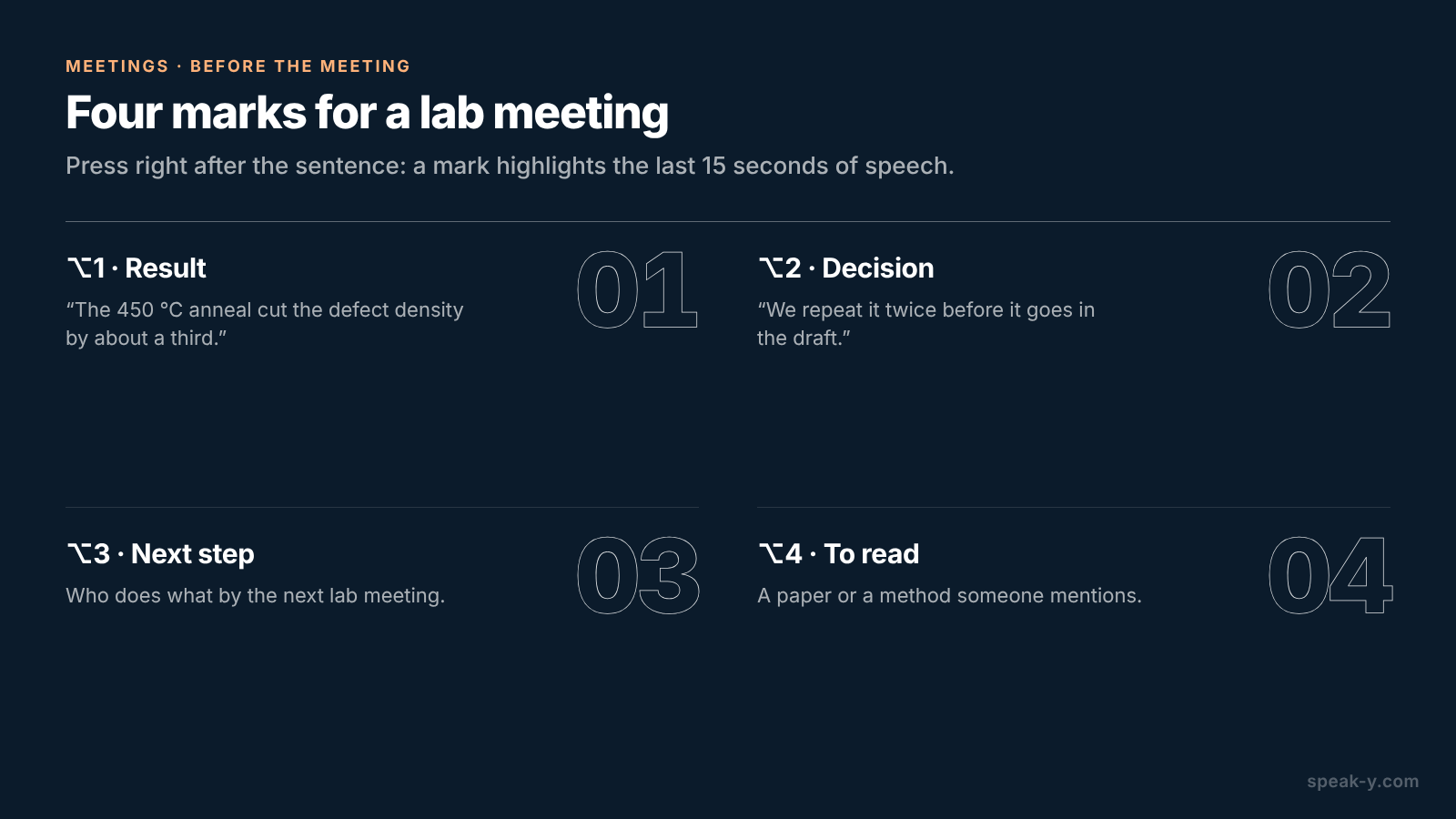
Name your marks. Open Settings → Notes. Under Note types, rename the default Mark the moment and click Add note type for the rest; Set hotkey gives each its own combination. Four types fit a lab meeting:
- ⌥1 Result — a number someone presents: "The 450 °C anneal cut the defect density by about a third."
- ⌥2 Decision — what the group agreed: "We repeat it twice before it goes in the draft."
- ⌥3 Next step — who does what by the next meeting.
- ⌥4 To read — a paper or a method someone mentions.
Each press pins a mark of that type to the transcript and highlights the words of the last 15 seconds, so you press right after the sentence, not before it.
Last, pick one tag — Nadia uses lab-meeting — and put it on every lab
meeting, so the recordings list filters them in one click.
In the room: one click, two keys
A lab meeting in a seminar room has no call app for Speak-Y to recognise, so start it yourself: press your Speak-Y hotkey in hands-free mode, point at the recording button and click the check mark on Record as Meeting?. Voices reach the app through the Mac's microphone, so put the laptop in the middle of the table, not at the presenter's end. If people join from home, Zoom, Microsoft Teams, Webex and other call apps are recognised as soon as they are open, and Speak-Y asks Record as Meeting? by itself. For the question to appear, Settings → Interface & Behavior → Meeting mode must be Manual or Auto.
Then listen. When a student presents a number, press ⌥1; when the group settles something, ⌥2. Speak-Y records voices, not slides, so ask presenters to read key values aloud — "sample B, 450 degrees, two hours" — and they land in the transcript next to your mark. Pro+ records meetings of up to 4 hours, which covers a long meeting with several presentations.
After the meeting: names, the tag and the lab channel
Open the recording from Meetings. Speakers are numbered in the order they spoke; you are usually Speaker 1. If Speak-Y has already put a name on a speaker, check that it is right.
- Click each speaker chip, type the person's name and press Enter. The channel feed, copied quotes and what an AI assistant reads later all use this label.
- Click Tags and add
lab-meeting. - Press To channel under the transcript and pick Lab meetings.
Channel members get the transcript with speaker names and the summary; the audio stays on your Mac. Your marks stay private on a shared recording until you switch them to show in that channel, which is worth doing for a lab meeting: the group then sees each Result and Decision in the feed.
Creating a workspace needs Pro or higher, and the people you invite join on any plan, including Free, which matters for a lab where students pay for nothing. Setting up a team workspace covers the first steps.
A new student: the channel history instead of a retelling
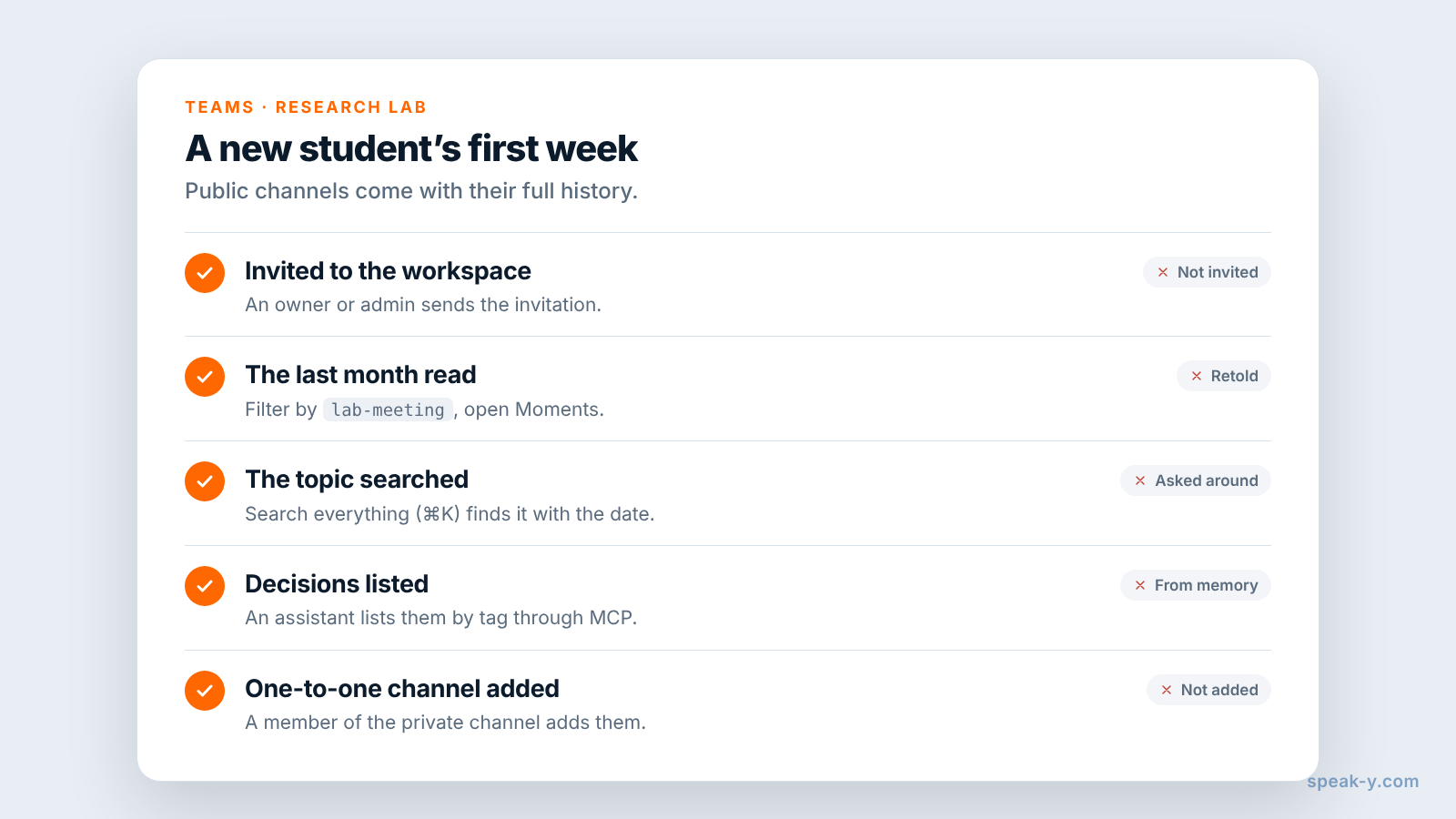
When a new PhD student arrives, an owner or admin of the workspace invites them. A new member receives the current keys and sees the full history of the workspace's public channels: every lab meeting shared to Lab meetings since the channel was created, with names, summaries and the moments you made visible. The first week can then look like this:
- Read the last month. Filter the recordings by
lab-meetingand read four meetings in order; the Moments tab in each shows only the marked lines. - Search the topic. Search everything (⌘K) matches transcript text, so "annealing" finds every time the group discussed it, with the date.
- Ask an assistant. With the Speak-Y MCP server connected, an AI assistant reads the recordings shared into your channels, filtered by tag and date: "List every Decision in meetings tagged lab-meeting since September, with dates" gives the newcomer the group's choices in one page. Play a moment before you rely on it.
Private channels are different: a new member does not see them until a member of that channel adds them.
One-to-ones: a private channel with two members
Supervision meetings are not for the whole group. For each student, create a channel in the workspace's ⋯ menu: choose New channel, switch the type to Private, tick the student under Who can see this channel and click Create channel. Nadia has Nadia · Ines for her second-year student.
- Members only. A private channel does not appear for anyone else in the workspace, the owner included. It is encrypted with its own key, held only by its members' devices; the server cannot read its transcripts or its name.
- The creator controls membership. Any member can add someone, but only the creator can remove a member; removing one rotates the channel key.
- Private from the start. A public channel can never be made private, because everyone already has its history.
- The Recovery Kit is a key too. The workspace Recovery Kit can restore access to a private channel. Keep it with the lab head, not on the group's shared drive.
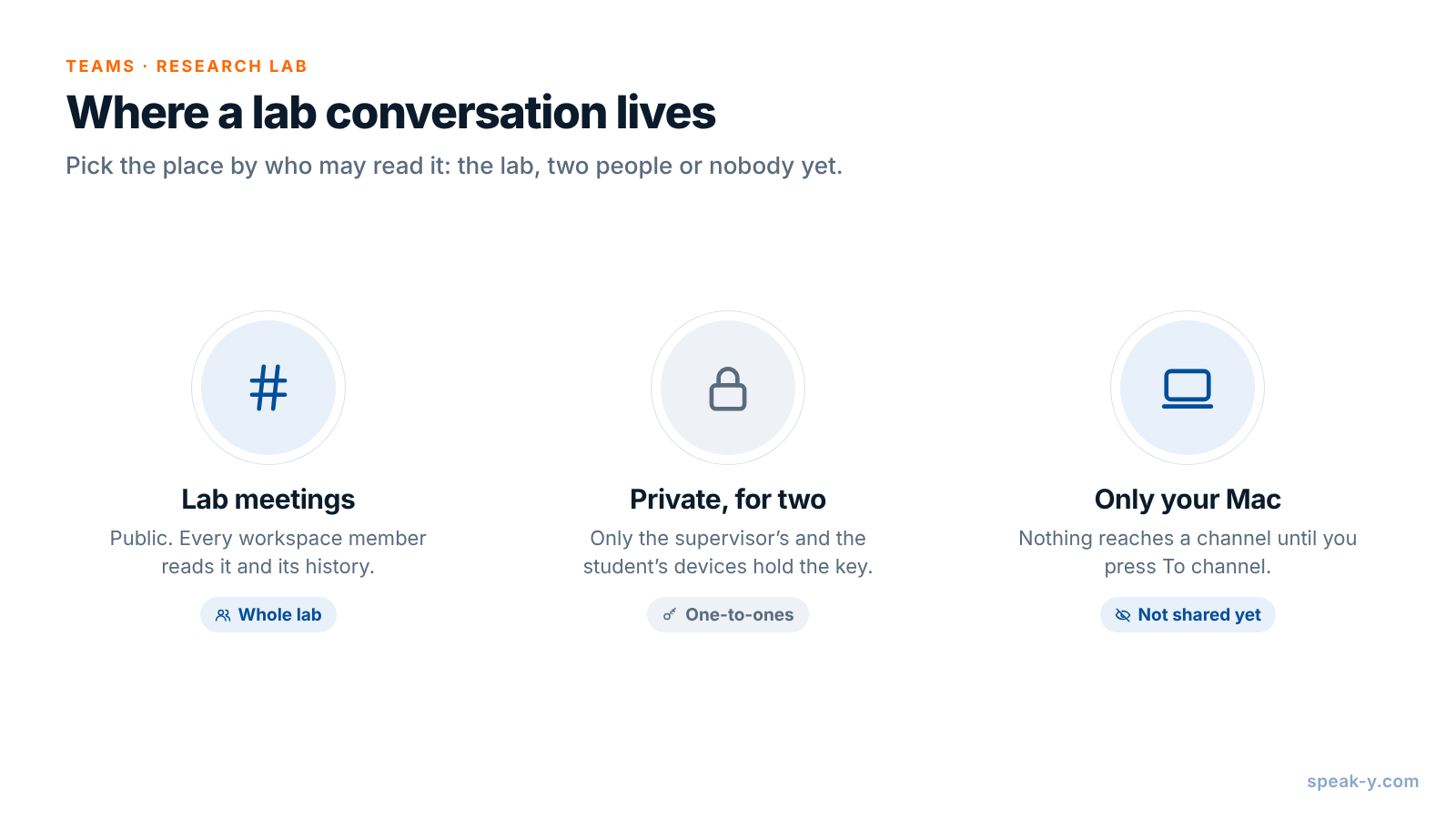
A recording reaches no channel until you press To channel, so a conversation that belongs to nobody yet can simply stay on your Mac.
What Speak-Y does not replace
Speak-Y keeps the conversation, not the research record. The lab notebook stays the record of what was done: NIH's guidance for its own researchers describes it as documenting research in enough detail that others can reproduce it, and a transcript of someone describing an experiment does not meet that bar. Research data stays where your data management plan puts it; for NIH-funded work, the Data Management and Sharing Policy has required such a plan with applications since 25 January 2023. Speak-Y does not store instrument files or sync with your notebook.
When a student graduates or leaves, remove them from the workspace: the app rotates the keys of the workspace, its public channels and the private channels you are in, so new recordings never reach them. What their app already downloaded stays on their Mac, as with any file someone has already opened.
One workspace, one public channel for the lab meeting, one private channel per student: the group shares its memory, and a newcomer starts from the history. The Teams page explains workspaces, private channels and encryption in one place.
FAQ
Can Speak-Y record an in-person lab meeting without a bot?
Yes, on a Mac. Start a recording with your Speak-Y hotkey in hands-free mode, point at the recording button and click the check mark on Record as Meeting?. Voices in the room reach the app through the Mac's microphone, and a hybrid meeting in Zoom or Microsoft Teams is recognised as a call. Nothing joins the meeting, so nobody announces the recording for you.
How does a new PhD student catch up on past lab meetings?
Invite them to the lab's Speak-Y workspace. A new member receives the current keys and sees the full history of the workspace's public channels, so every lab meeting shared to the Lab meetings channel since it was created is there to read, with speaker names, summaries and marked moments.
Where should supervisor and student one-to-ones go?
Into a private channel with two members: the supervisor and the student. A private channel appears only for its members and is encrypted with its own key that only their devices hold. Create it as private from the start, because a public channel can never be made private.
Does the lab need to get consent before recording a lab meeting?
Ask every time. Some places require the consent of everyone recorded, for example California under Penal Code section 632 for confidential conversations, and your university may have its own rules. Say at the start that the meeting is recorded and that the transcript goes to the lab's channel.
Can Speak-Y replace the lab notebook?
No. The lab notebook stays the record of what was done, with enough detail for someone else to repeat it, and research data stays where your data management plan puts it. Speak-Y keeps what was said in the meeting, by speaker and with times, so decisions and results can be traced back to the conversation.